
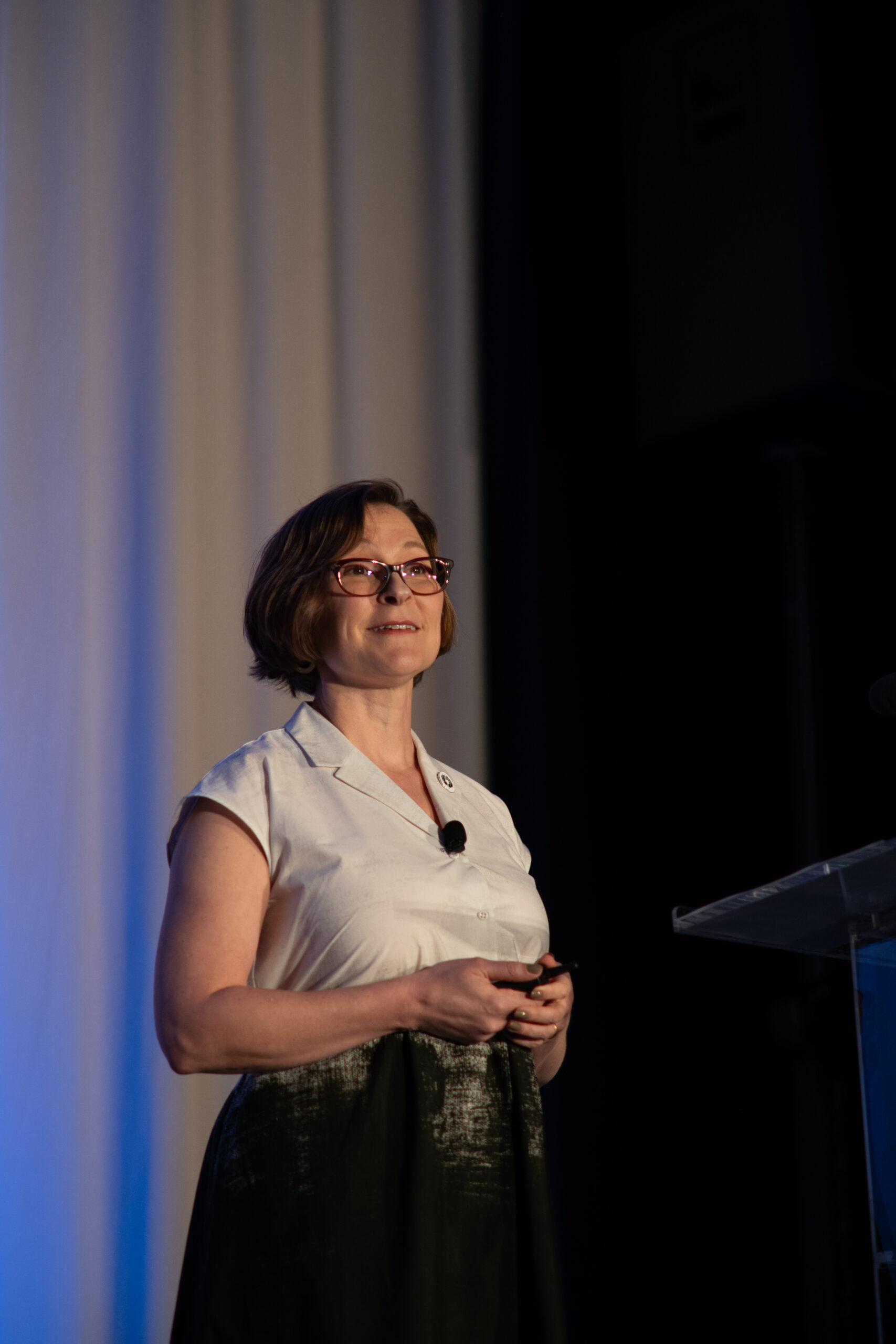
Each year, Lindsay Baker, Living Future’s CEO, brings clarity and perspective to the state of the regenerative movement and the role each of us plays within it. This year’s message feels especially urgent. In her keynote, she reflects on the signals emerging around us, what people in power often do when they feel threatened, and how we can stay connected, focused, and effective as we work to scale progress together.
This year, she was interrupted midway through her keynote by a fire alarm. Though it turned out to be a false alarm, it persisted long enough that the entire room witnessed Lindsay’s humor and grace as she continued speaking through the disruption — an almost too-perfect metaphor for the moment we are living in.
We’re sharing the full keynote transcript here, along with links to watch the replay or listen to the re-recorded version of the talk. All Living Future 2026 mainstage talks, announcements, and award presentations are available for Professional Members to watch in the Living Future Community.
Designing for the Next 100 Years
When we set this theme of the next one hundred years, it was out of a desire we had that I’m sure we all feel, to pull ourselves out of these particular times, this disorienting present moment, and reground ourselves in a longer arc of history. This practice of considering longer arcs of time is uncommon for most of us these days. But it has the potential to better ground us in our work, to help keep us sane, and to help us find usefulness and joy when those can be elusive.
So I’ve been finding a little time to listen to the wisdom of people I trust who have been also thinking about these times, from that longer arc of history. And what unprecedented times they are. And I trust that this is a community that shares many concerns about what is happening in the world today, especially in the U.S., because what brings us together are common values around climate action, social justice, human health, community and economic health, and leaving our world better than the way we found it. And so I think it’s important for us to use this time to understand our collective work in the context of what is changing and shifting in our world, so that we can thoughtfully act and ultimately succeed in our efforts to transform the building industry. The challenge ahead to create a regenerative future is still here, and we must make the best design decisions we can in the context of this 100 year frame.
One wise teacher who has helped me in this thinking recently is the Canadian journalist, professor and past Living Future keynote speaker, Naomi Klein, and I want to spend a moment sharing her observations and suggestions with you all.
Klein was interviewed in March 2026 by the NYTimes journalist Ezra Klein on his podcast about her 2023 book, Doppleganger, and her upcoming book which will come out in September. The podcast episode is called “We’re All Living in the Mirror World Now”, and in it she shares deeply thoughtful observations about the political context we are in and what we can do next.
Before I go into this, I’ll say that I know many of us come to Living Future to get inspired, and I know that talking about our current political landscape is not very uplifting. But, first of all, I promise I have an uplifting message that I hope can help us all orient ourselves right now. And second, we are living in times where some actions we take (or don’t take) this year will likely have consequences for the next 100 years. Our actions matter, and we are a community that believes that a small group of people can catalyze deep change.
Our actions matter, and we are a community that believes that a small group of people can catalyze deep change.
In Klein’s interview, she talks about how she has been studying the history of fascism, and the recent growth of this type of political activity that is happening in some parts of the world. And she starts by reminding us where the term ‘fascism’ came from, and where the idea started. She says:
“Fascism is a pathology of injured power. It emerges in… the injuries of the first world war… It’s powerful people who are hurt. It’s these vertical coalitions that get built by people who had relative power that are losing power…. So, if we are in a fascist moment, then it is a counter revolution. We have to understand what elites are revolting against. Who hurt them, what hurt them? And I think part of what they are revolting against was that there was starting to become some accountability”
She argues that some of that, perhaps centrally, is women who were starting to hold powerful men accountable. The last bit I’ll quote from here is: “And so this unleashing of the far right is partly them protecting themselves” she says.
accountability
noun
: the quality or state of being accountable
especially : an obligation or willingness to accept responsibility or to account for one’s actions
Similiar: responsibility, obligation, duty
This connection she drew really struck a chord with me. She argues that it is really the success of people holding the powerful to account that can lead the powerful to fight hard against being held accountable.
Although she is talking about a different realm of accountability, it immediately struck me that relates to some of what I’ve been grappling with lately. I’ve spent my whole adult life building systems of accountability. Rules that we can all live by, fair ways to measure and draw a line and say ‘this is good enough’ and ‘this is not’. I’ve always believed that if we could get the rules right when it comes to how we build, that we could hold each other accountable to live within our means. And we have built a movement on that premise. And not just us here, but so many people who do adjacent work. People who fight for climate action via the Paris Agreement or the greenhouse gas protocol. People who fight for better building codes, people who fight for fair labor practices. Building systems of accountability and then advocating for them is a huge tactic for those of us who fight for a better world.
Pushback Is Rising
But since the election, I had been questioning it more. We are seeing push back more and more now against the concept of green building, sustainability, etc. And we have seen the rollback of a good deal of regulation that promotes green building practices and certification in some parts of the country and the world. It is being blamed for the housing affordability crisis. And I think I’m not alone here. Many of us have been feeling shaken, less confident than ever about the goals of our movement. Maybe it is too expensive? Maybe we are being too demanding? Maybe accountability has gone too far and is too time consuming or bureaucratic, too woke? Maybe it’s too prescriptive and we are limiting creativity and innovation?
We Are a Force to Be Reckoned With
Hearing Naomi Klein frame this notion of the power of accountability, of holding each other to account, it really struck me. She reminded me in that moment that sometimes the backlash comes because the action is actually working the way it was intended to, and the small minority of powerful folks who stand to actually lose from fair systems of accountability find ways to start fighting. So they take a lot of time and energy and money to find arguments to enable the push back. They attack the premise of our work, they say it makes things more expensive by tying business up in red tape, they say it takes jobs away. But we know, in this room, that a central goal of the green building community is actually to save people money, to make homes more affordable, and to create good jobs. So rather than let ourselves be cast as the villains, what do we do? I have two suggestions for our collective strategy.
The first is to acknowledge when our systems of accountability are not working well, and to fix them to make them more fair, less bureaucratic, less expensive. And similarly, we need to be careful to only create systems of accountability that are fair in the first place. I want to be clear, I don’t think fixing things is going to stop the backlash. The backlash originates from those who make their living off of fossil fuels, who need to exploit others for their power and wealth to be maintained. But we need to make sure that our systems are not unnecessarily expensive or onerous, because it matters to everyone. And by putting that care into our systems and our advocacy, we can make our work more appealing for all. For example, we can work to avoid overly prescriptive codes that require purchasing expensive appliances rather than requiring good performance. We can streamline our paperwork and processes to reduce the cost of delivering good buildings through the wise use of technology platforms.
It takes all of us to consider how we can reduce confusion and unnecessary cost to achieve our collective goals.
And I have a number of exciting updates on that front, in terms of what Living Future is doing. We announced last fall that we have formed a partnership with four other building certification nonprofits to align our programs’ requirements for materials sourcing with each other, to reduce administrative burdens and market confusion. We are launching a new data platform for our Declare program that will allow for more seamless interoperability between our Declare database and other tools and data systems in our ecosystem. And we are launching a new version of the Living Building Challenge this year, version 5.0, which will refine and evolve our flagship program to better enable more people to participate in it. These all have been informed by our collaboration efforts, and I’m so proud to be seeing that work coming to fruition. But nonprofits are not the only ones who need to align and collaborate. It takes all of us to consider how we can reduce confusion and unnecessary cost to achieve our collective goals.
It also takes all of us to stay committed to accountability. It means committing to transparency of product ingredients, of company operations… continuing to put time into reporting and certification… Another aspect of this is that while we do need to talk to each other about how to improve our programs, we need to be smarter about where we share our concerns and consider who is listening. Might that person turn a healthy critique into a reason to opt out of our systems of accountability wherever it suits them? We need to learn to use our words more carefully.
The second activity is to fight hate with love. As Klein says, the source of a lot of backlash is hurt. Well, for all you regenerative practitioners in the room, this sounds like a call to action! We understand the power and the imperative of starting by asking “what hurt has been caused, what needs to be healed here?”
Regenerative design has the power to enable that healing.
I think this is why we’ve seen a real surge of attention towards the subject of regeneration for the past couple of years. Sure, some of this is just the trend cycle- many of us are looking for a new word that doesn’t feel demonized by others, doesn’t feel ‘old’, or weighted down by bureaucracy. But I think it’s more than that. I think we are all looking for a way to help resolve the issues of our time through listening and healing rather than through fighting and destruction. Regenerative design has the power to enable that healing. We learn from the wisdom of nature, we learn from many indigenous practices, and we inevitably find pathways to heal what has broken, and to provide abundance for all of us, towards the living future that we are seeking. Regeneration, when practiced deeply, is a way out of the vicious cycle of scarcity mindsets and us versus them. and so if that resonates and you’re new to this community, we can’t wait to meet you and welcome you into this way of working. We are growing as a movement, perhaps because more people than ever before want to be healers, and let me tell you, there is so much healing to be done.
And if this sounds weird to imagine that buildings and products can heal, let me just give you a few examples from this past year.
From my neck of the woods, in San Francisco, a project called The Kelsey Civic Center opened. This affordable housing project is right in the middle of the city, and a model of regeneration and healing. This project was a part of our Affordable Housing pilot program, and is pursuing our Core certification. Eight stories, 112 units, 25% reserved for people with disabilities. It’s a beautiful project that I know the whole team at Living Future has been cheering on, and we published a fabulous case study on the project that you all can find here at the conference, find Lea, or you can join the panel on the project on Wednesday afternoon!
Another project that I hope we can all find inspiration from is the work that members of our community are doing in Lahaina, on the island of Maui in Hawai’i. Since the devastating wildfires that destroyed much of the town in 2023, some of us are working on building homes there using regenerative principles and the Living Building Challenge as a guide. This is what healing looks like, folks. They have a poster out in the poster area if you want to find out more, and I think that the team is still looking for help getting good nontoxic building materials sourced that they can get on the island.
As you all will not be surprised to hear, one of my favorite stories of regeneration from the past year is the incredible explosion of adoption of biobased building materials. It has been an awesome year for some of our healthiest, lowest carbon and most ecologically restorative materials from strawbale to hemp to biochar, sustainable wood and more. I’m so grateful for this community taking up the charge from last year’s conference to learn more about these materials, to create EPDs for them, to start trying to specify them in your projects. We are seeing the growth of these deeply local businesses, creating skilled jobs in our communities, and showing the industry that we can build without petrochemicals. For those who are free on Thursday evening, I understand that there’s a side event on the topic at Perkins & Will’s offices.
What We Stand For
This is the kind of work we stand for here at Living Future. Let’s not let ourselves be cast as bureaucrats who want to add burdens to normal working folks, or who are out of touch with what it means to get by in our world. Let’s remind ourselves and others that we are about life, thriving, healing, and community. And, we hold each other accountable for acting in ways that support life and community, ways we can measure and be responsible for. We have a community that shows that climate action is not bureaucratic, not costly, that social justice work is fair and needed, that carbon accounting is evolving towards a solid, credible system.
So, in case you need a refresher, or if you are new, I thought it might be useful to take this moment to remind us what we stand for. Call it a pledge or a manifesto of sorts, but I put together this short list based on what I hope we already know about ourselves. But in times of self-doubt, or when we aren’t quite sure we are aligned on what we are aiming for, I hope you can use this as a reference.
- We value all life, so we act to help create and sustain life.
- We can and should be building within the constraints of our planetary boundaries.
- So, we create buildings that show that regeneration is possible.
- We work for our communities and our planet, not just our paying clients, because we believe that it is right and necessary for our survival and flourishing.
- We have a right to know what is in our supply chains, because our choices about the materials we use can make or break our ability to live within the bounds of our planet.
- After we make decisions, we follow through and make sure they have their intended impact, and we build feedback loops and accountability to help us do better next time.
- We codify certifications and regulations to hold each other accountable.
- Our goal is to shift the entire market towards these practices, so we lead by example. We are the vanguard, the scouts, but we don’t lose the pack. We enable others to join us.
What will follow in the next two days is a set of conversations that we are all a part of, as we share our lessons learned in these pursuits, as we help each other, form community, support our new folks in finding their contributions, and celebrate what we have accomplished in our journey together so far.
And along the lines of healing, I want to encourage us to remember that the Living Future conference is a great place and time to heal and strengthen our community. There are some real threats to our movement, people who really do not agree with these statements because they don’t serve their interests of maintaining power. And so I want to ask us all to think about someone who maybe you’ve been angry with in your work recently, someone you know, someone maybe in our community whose opinions you disagree with, or someone who you think really messed up or did something harmful. I want you to ask yourself: do you think they believe in these goals? Do they ultimately want the same world change that you want? If the answer is no, we are here to help you in your quest to change their mind. But if the answer is yes, they want what you want, I want to encourage us all to use this time together, this year, to work on our own relationships and strengthen our community so that we can be better able to confront the real threats we face in our work, rather than wasting too much time fighting with each other. Remember, when resources are scarce, it can make us turn against each other, and that only keeps us further away from our goals.
We put together a program at Living Future 2026, and I promise we will do this again at Living Future 2027, to help us all find our strength in this work, and to place ourselves in a healthy context with this longer arc of change in our world. We chose our two keynote speakers this year, Matthew Thompson and Katharine Wilkinson, because they are deep thinkers who help us engage with a longer arc of change, as well as consider how best to stay engaged, helpful and grounded in the long term. We have stories from folks doing inspiring work on the ground, building new business models, new networks, and finding wisdom and relevance from that which may feel old and even ancient.
And of course, we will do a lot of celebrating of the accomplishments of this past year, and our 20th anniversary of the Living Building Challenge!
This is a time to iterate, to listen, to adjust, but ultimately to stay firmly accountable to this collective work.
This is not a moment of giving up on our systems or our values. This is not a moment to fight amongst ourselves. This is not a moment to believe the rhetoric that our tactics have been ineffective or unfair. This is a time to iterate, to listen, to adjust, but ultimately to stay firmly accountable to this collective work. As always, I’m honored to be doing this work with you all and to be supporting you.
On behalf of the whole team at Living Future, thank you for your commitment to our collective work, and thank you for joining us for this 20th year of the Living Future conference.