
Coliseum Place. Image by Bruce Damonte, courtesy of David Baker Architects.
New Case Studies From Living Future’s Affordable Housing Pilot Projects
Editor’s Note
Join us for the 2025 Affordable Housing Summit on August 7th & 8th! The theme for this virtual event is Strength in Community, and we have planned an agenda to demonstrate how we are collectively maintaining our resolve towards affordable housing that is healthier, more resilient, and on the path to equitably decarbonize. Register here. We hope to see you there!
At Living Future, we envision a world where everyone has access to healthy, regenerative homes. Through our Affordable Housing Program, we’ve spent over a decade partnering with more than 65 affordable housing pilot projects–offering technical guidance, developing resources, and fostering a supportive peer exchange network with the shared goal of delivering positive outcomes for under-resourced communities. Together, we aim to advance the affordable housing sector towards a living future for all.
The Living Building Challenge, Zero Carbon, and Zero Energy Certifications serve as both guiding frameworks and powerful tools in pursuit of this vision. For us, regenerative impact is measured through actual building performance, with a focus that goes beyond environmental outcomes to center the lived experiences and well-being of residents and communities.
We recently checked in with three pilot projects from our Affordable Housing Program to learn about how engaging with Living Future’s certifications helped to shape the quality and performance of their buildings, even years into occupancy. Our newly-published affordable housing case studies feature an Austin-based project that achieved Zero Energy Certification in 2018, a 59-unit development in Oakland that has been fully occupied for three years, and a more recent project in La Grande, Oregon, that opened its doors to residents just last year.
Learn more about each project below.
Case Study Highlights
Lakeline Station Learning Center
8 Year Post-Occupancy Update

Serving as a vital education and community hub for the 128-unit Lakeline Station Apartments, the Lakeline Station Learning Center was the first Zero Energy certified commercial building in Austin. Completed in 2017, it stands as a testament to how prioritizing resilience and sustainability education can cultivate vibrant, thriving communities.
When Texas was hit by Winter Storm Uri in 2021, the building’s renewable energy system helped offset surging operating costs, allowing essential funds to be redirected toward resident services. During that same storm, the site’s native, drought-tolerant landscaping also proved remarkably resilient under extreme conditions. Today, most of the site’s irrigation needs–as well as water used for toilet flushing–continue to be supplied by large rainwater collection cisterns flanking the building’s facade. Lessons learned from this project have directly informed Foundation Communities’ broader approach to energy resilience and climate action in the years since. As a model for sustainability education, the Learning Center offers a green education curriculum rooted in the principles of regeneration, climate resilience, and environmental justice.
The building’s selection of primarily Red List Free interior finishes has been a major success, with Forbo Marmoleum flooring–praised for its durability–becoming the standard across all Foundation Communities’ learning centers. Building on this success, the Developer has committed to deepening their healthy materials work by participating in the Safer Materials Shift, an 18-month project led by Living Future that aims to transform materials research and vetting processes, accelerating the use of Red List Free building products in the affordable housing sector.
Read the Lakeline Station Learning Case Study
Coliseum Place
3 Year Post-Occupancy Update

Adjacent to the Coliseum BART station, Coliseum Place provides affordable homes and on-site social services for low-income and formerly unhoused families in Oakland, California. Three years after welcoming its first residents, the six-story, all-electric building has achieved an energy use intensity (EUI) that is 51% lower than an comparable baseline building, with its rooftop photovoltaic array supplying 30% of its total annual energy. This performance reflects an intentional balance between innovation and practicality, with strategies that include a decentralized hot water distribution system and careful attention to installation quality during construction of the building’s thermal envelope.
Beyond its strong energy performance, Coliseum Place fully embodies its overarching design intention: to reconnect residents to nature and to each other. The thoughtful application of biophilic design principles is evident in its highly visible green “core” and pass-through view corridors, with a facade enveloped by a perforated metal shade screen that mimics the dappled light beneath an oak tree. The building’s lobby, with its custom seating and kinetic sculptural ceiling, evokes the experience of standing beneath a tree canopy–to the delight of residents and guests alike.
According to David Baker Architects (DBA), one of the outcomes of participating in Living Future’s Affordable Housing Program has been the opportunity to engage more deeply with material health considerations and the Red List. This has resulted in more robust materials vetting and specification processes within their team. Like Foundation Communities, DBA has since joined the Safer Materials Shift, further solidifying their commitment to prioritizing healthy building products in their work.
Read the Coliseum Place Case Study
TIMBER Ridge
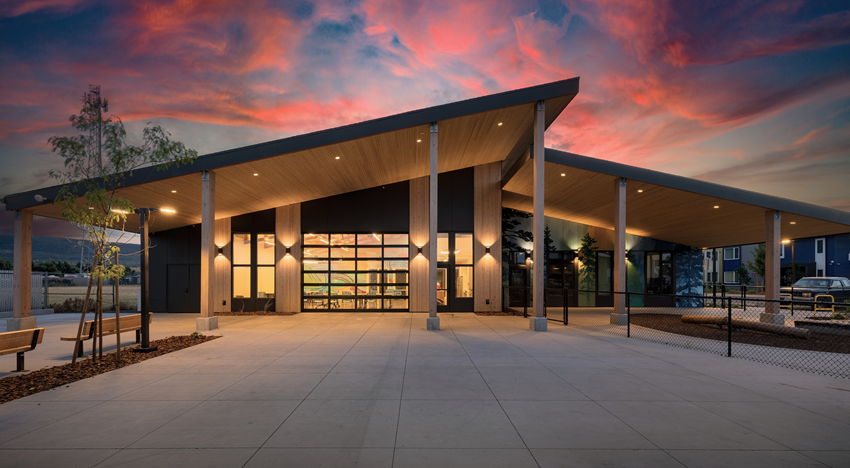
Set amid the picturesque views of Northeast Oregon’s Grande Ronde Valley, Timber Ridge Apartments is an 82-unit intergenerational community consisting of eight residential buildings and a 4,500 square foot community center. From pursuing Zero Energy Certification to eliminate the burden of energy costs to incorporating trauma-informed, biophilic design principles in its architecture, the project embodies a strong commitment to centering resident needs throughout every development decision.
With its varying roof lines, large timber posts, and vibrant murals inspired by the surrounding landscape, the design of Timber Ridge is deeply place-based. Resident well-being and psychological safety were top priorities for the project; to honor the life experiences, struggles, and aspirations of its residents, the team applied a trauma-informed design framework grounded in the principles of connection, comfort, and choice. This is reflected not only in the biophilic design elements woven throughout the community, but also in the circulation layout, apartment configuration, and the use of The Kelsey’s Inclusive Design Standards to guide the design process.
Despite the challenges posed by the COVID-19 pandemic during development, Timber Ridge has demonstrated how thoughtful collaboration around a shared vision can result in transformative outcomes. Completed in 2024, the project is now collecting energy data as it moves toward its goal of achieving zero energy performance in the near future.
Read the Timber Ridge Case Study
Visit our website to discover more about Living Future’s Affordable Housing Program and the other projects we support.