Skanska is a leading construction and project development company with markets in Europe and the United States. An early adopter of the Living Building Challenge, Skanska has built or consulted on over a dozen fully certified Living Buildings, and many more that have embraced some aspect of the Challenge.
Myrrh Caplan, Senior Vice President for Sustainability at Skanska USA Building, was involved in Cascadia chapter of the U.S. Green Building Council when the Living Building Challenge first launched. She calls it a “light bulb” moment that has radiated out from the Pacific Northwest and reached across the globe. From the beginning, Caplan has been a staunch advocate of the Challenge.
A discussion with Caplan reveals how Skanska has evolved alongside the Living Building Challenge and other initiatives, what’s gotten easier, what remains a challenge, and how Skanska is helping advance holistic sustainability across the industry.
Laying the Groundwork
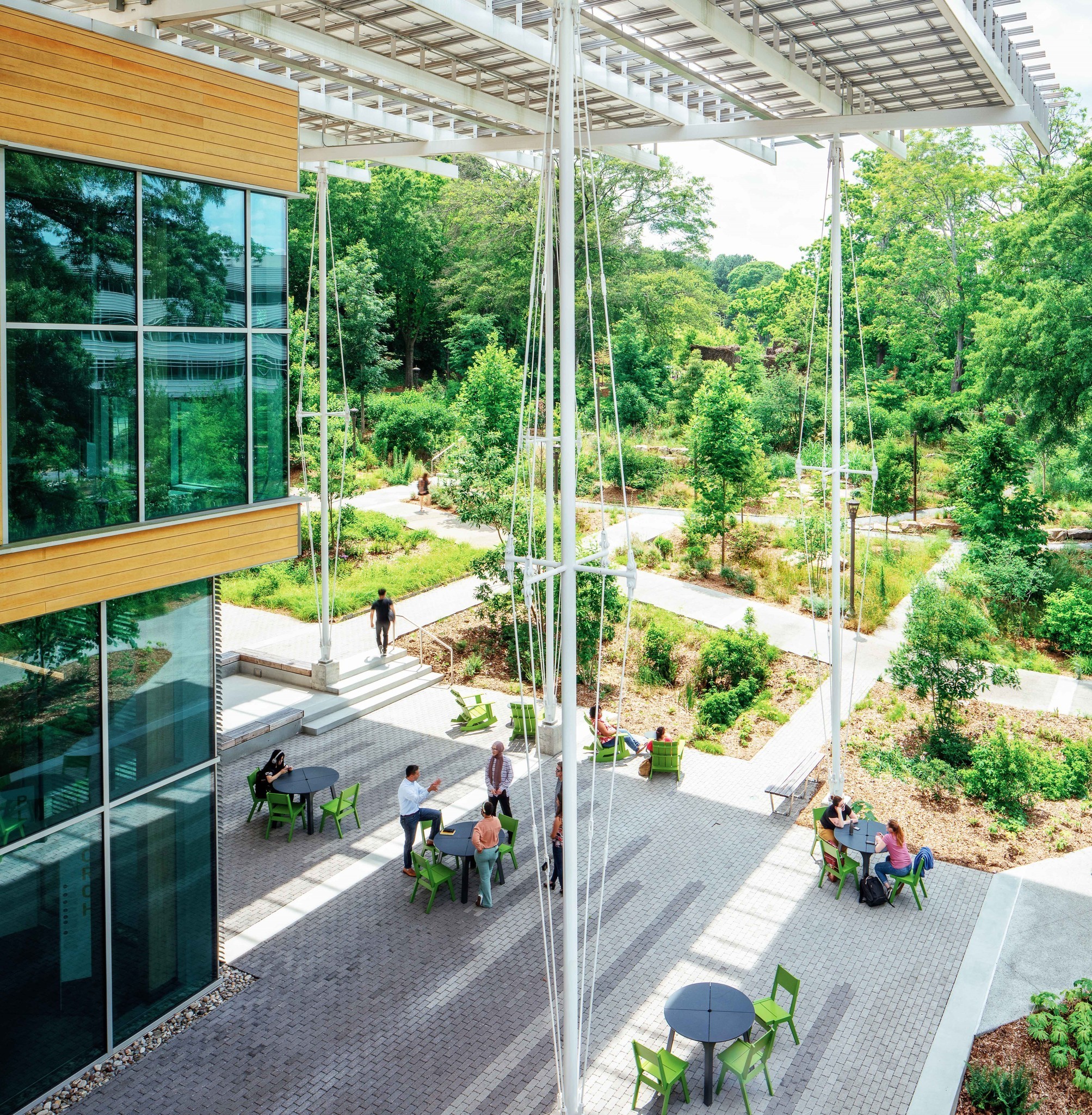
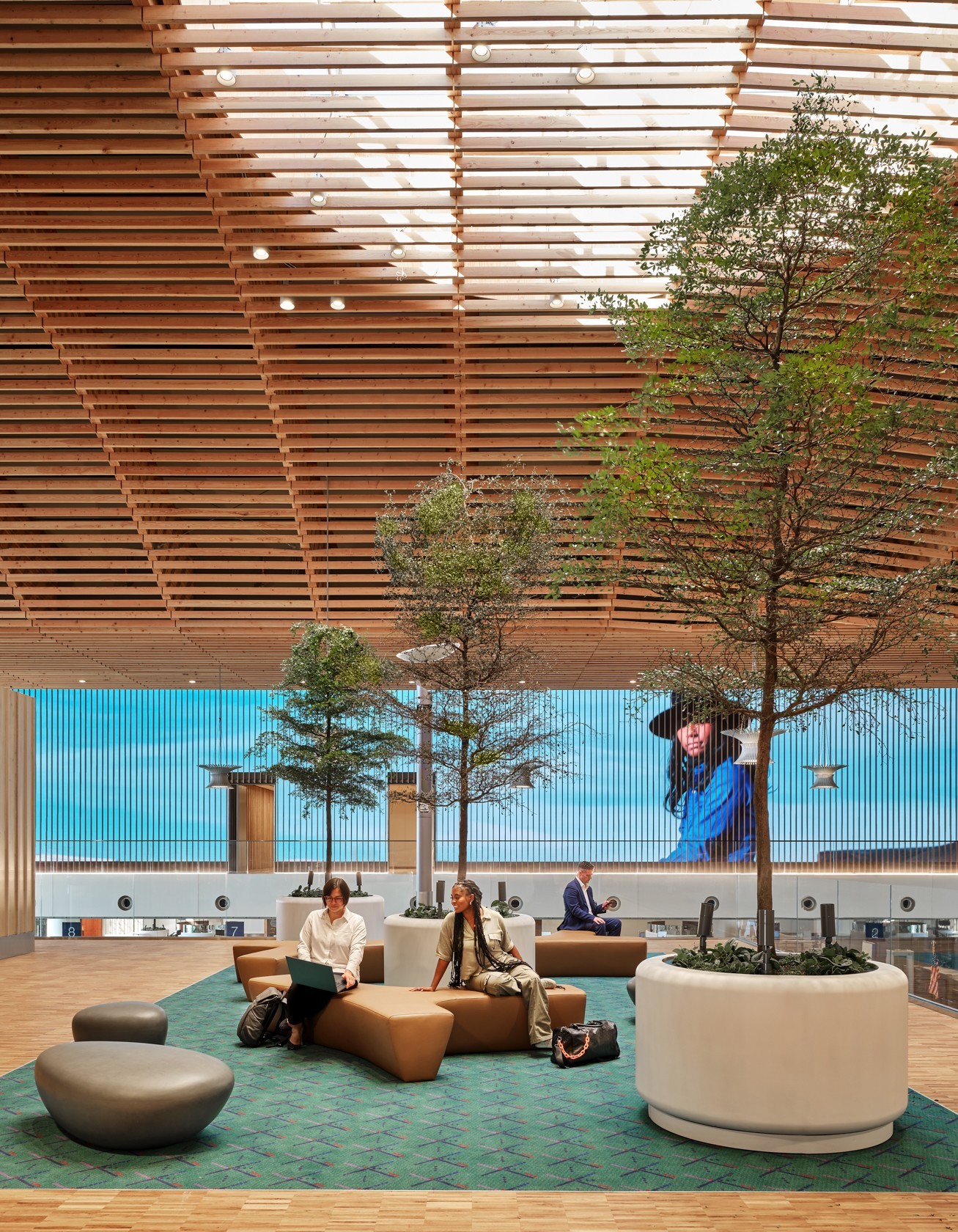
Skanska had a hand in many of early Living Buildings, starting with the Bertschi School, an elementary school science wing in Seattle, Wash. that achieved certification under Living Building Challenge 2.0. Other projects followed, including the Brock Environmental Center on the shores of Chesapeake Bay in Virginia Beach, Virginia, and the Kendeda Building for Innovative Sustainable Design on the campus of Georgia Tech in Atlanta, Georgia (version 3.1). More recent projects include the stunning renovation of Portland International Airport (PDX), with its nine-acre mass timber roof (“We’re mass timber geeks,” says Caplan) and Roswell Community Masjid in Atlanta, which aims to be the first place of worship to achieve Living Building Challenge certification.
Public and educational projects in particular allow many people to connect with how a Living Building functions and feels. “We want everyone to have that experience; that’s the goal,” says Caplan.
Projects like these have served as beacons—shining examples of what is possible. The task now, as Caplan sees it, is to facilitate wider adoption and larger-scale projects.
A good example is the New York Climate Exchange campus on Governor’s Island. The Exchange, which includes both new construction and adaptive reuse of historic buildings, will serve as a global hub for climate research, education, convening and innovation. Skanska is construction manager on the project.
The new building, which is aiming for full Living Building Challenge certification, consists of two mass timber structures connected by an undulating roof and solar canopy. It will include classrooms, a living lab, and auditorium space.
“It will be something people will see every time they decide to take that water taxi across from Manhattan and go to Governor’s Island,” says Caplan.
It takes particular expertise to deliver an LBC project. Over the past 20 years, one of the most significant shifts Caplan has witnessed is growing interest and awareness among building owners in pursuing the Living Building Challenge or aspects of it. In response, Skanska has grown its consulting practice.
Kendeda Building at Georgia Institute of Technology | Photo courtesy of Skanska
“In recent years, owners have been talking to us more and more about their aspiration to meet the full Living Building Challenge or some aspect of it.”
Myrrh Caplan
Part of the job is nuts and bolts—helping teams navigate material supply chains and integrate circular thinking while staying on budget, for instance. Another part is more esoteric. “Part of our job as the consultant is to help customers understand their sustainability options on their projects, to result in the most meaningful impacts,” says Caplan.
These projects are special, not just because of what they accomplish, but because of the unusually tight-knit culture of project teams.
“You’re committing to that relationship with everyone who’s involved; there’s a certain emotional connection,” explains Caplan.
“We collaborate with clients to provide our expertise, and recommended solutions that demonstrate where sustainability can be a viable option that delivers projects safely, on time, on budget, and aligned with the client expectations.”
Shifts in the Industry
In addition to growing owner interest, manufacturers have embraced transparency, which has made product vetting much easier. Not only do designers enjoy greater selection, they can suggest product lines that worked on another project.
Caplan serves as co-chair on the board for mindful MATERIALS, which is developing the Common Materials Framework, a shared language for sustainable building products that organizes hundreds of ecolabels and standards into five impact areas.
The Common Materials Framework allows project teams to vet products through a particular lens, whether Human Health, Ecosystem Health, Social Health & Equity, Circularity, or Climate Health. “We need to make it easier to choose materials based on the factors that are important to that owner,” says Caplan.
Caplan has also seen a big shift around energy performance.
“On some of those earlier projects, when we’d be talking about net-zero or net-positive energy, the biggest conversation would be around solar panels,” says Caplan.
Solar is a “fantastic solution,” she adds. “But especially back then, the cost per kilowatt hour of solar panel installation could be far outside of an owner’s ROI window.”
As the installed cost of solar has dropped, the approach to energy performance has grown more holistic, considering how energy systems work in conjunction with the building enclosure, orientation, and other factors.
“There’s more thoughtfulness around all of that as a package,” says Caplan. “There’s also just greater opportunity in the technology space to choose more efficient systems that don’t need as much offset.”
Portland International Airport PDX | Photo courtesy of Skanska
Building a Sustainable Future
Collaboration is ingrained in Skanska’s culture, and the company is involved in several projects to help move the industry forward. A prime example is the company’s Supply Chain Sustainability School. First launched in the United Kingdom 14 years ago, the School is a free online learning platform created to support both sustainability and inclusion across the construction supply chain. After expanding to Australia and Ireland, Skanska USA brought the school to the United States in 2025.
By offering free, accredited training and practical resources, the platform helps level the playing field for companies of all sizes, where contractors, suppliers, and industry partners can share knowledge and learn from one another. Hundreds of learning modules, all free.
Anyone who wants to learn can take advantage of hundreds of free learning modules and CEs on everything from carbon accounting and indoor air quality to biodiversity and social equity.
In 2019, Skanska and industry partners released a free, open-source carbon accounting tool called the Embodied Carbon in Construction Calculator, or EC3. Housed under a nonprofit called Building Transparency, the tool uses environmental product declaration (EPD) data to quantify the carbon footprint of over 16,000 building materials.
EC3 was developed after the LEED program required manufacturers to provide an environmental product declaration to validate their carbon footprint. The EC3 tool translates EPD data into charts that show a product’s impact in relation to others.
“Now there are thousands of EPDs in there,” says Caplan. EC3 has become the go-to source for the industry to determine whether a product is good, better, or best in terms of its carbon impact.
According to Building Transparency, in markets where EPD data currently exists, using EC3 to select and procure low-carbon materials translates into a 30% or more reduction in carbon emissions.
While these initiatives are effectively helping move the industry forward, Caplan knows that for wide-scale adoption to happen, more people—especially younger people—will have to embrace the movement.
“We’ve laid the foundation,” says Caplan. “The big opportunity for us as the existing community around the Challenge is to find out how to attract everyone else to this movement.”
This article is part of a special 20th anniversary series celebrating two decades of the Living Building Challenge. Through reflections from contributors, practitioners, and project teams, we explore lessons from landmark projects, examine the program’s influence on the built environment, and consider what comes next for regenerative design.
Juliet Grable
Juliet Grable is a freelance writer and editor whose work covers a range of topics related to sustainability. Juliet is the author of two other Living Building Challenge case study books: Brock Environmental Center for a Living Chesapeake and Desert Rain House; she also served as editor on Creating Biophilic Buildings another Ecotone publication. Juliet has served as Managing Editor for Green Builder Magazine and has contributed to many national and regional publications, including Earth Island Journal, Sierra, Audubon, and Home Power. In addition to stories about regenerative design and construction, her writing covers innovative water systems, wildlife conservation, and watershed restoration. Juliet is grateful to live in Oregon’s Southern Cascades with her husband Brint, cats Pico and Binx, and pup Roca.
Declare
Highlights and Reflections from the Declare Equity…
ILFI uses cookies to help provide you with the best possible online experience. Please read our Privacy Notice for information about which cookies we use and what information we collect on Living-Future.org. By continuing to use this site, you agree that we may store and access cookies on your device.