
Recycled Content 101: Following the Journey of Recycled Materials
Recycled content is becoming an increasingly important part of how manufacturers communicate the materials used in their products. But a recycled-content claim can involve more than a single percentage. What counts as recycled content? Where did the material come from? How is it tracked through the supply chain? When recycled materials are blended with virgin materials, or used across multiple product lines, how can manufacturers determine how much recycled material to attribute to a particular final product?
Declare 2.1 introduces new options for reporting recycled content that help answer these questions while maintaining Declare’s focus on ingredient transparency.
Let’s take a closer look at what recycled content is, where it comes from, how it’s tracked, and why consistent accounting matters.
What is Recycled Content?
Recycled content is the portion by mass of recycled materials in, or attributed to, a product or packaging. These recycled materials may come from two sources: pre-consumer material and post-consumer material.
Pre-consumer Recycled Content
Under ISO 14021, pre-consumer material is material diverted from the waste stream during a manufacturing process. Materials such as rework, regrind, or scrap that are recovered and reused within the same process that generated them are not considered pre-consumer material.
For example, manufacturing offcuts that would otherwise have entered the waste stream may be recovered, reprocessed, and used to make a new product. Once that recovered material has been reprocessed and incorporated into a new product, it can contribute to recycled content.
Post-consumer Recycled Content
Post-consumer material is material generated by households or by commercial, industrial, or institutional facilities in their role as end-users of a product and that can no longer be used for its intended purpose. This also includes returns from the distribution chain.
Examples include:
- Glass bottles collected after use and recycled into new glass products
- Rubber recovered from end-of-life athletic shoes and incorporated into new flooring
- Products returned from a distribution chain and subsequently recovered as material
The distinction between pre-consumer and post-consumer material is important because the two sources represent different points in a material’s journey through the economy.



Why is Tracking Recycled Content Difficult?
Manufacturing is rarely as simple as 100 lbs recycled plastic in = 100 lbs recycled product out.
Real-world supply chains are often more complicated.
Recycled and virgin materials may be combined. Materials may be stored together and used to make multiple products. Production may happen continuously over time. In these systems, the specific recycled material put in may not be physically identifiable in every product leaving that system.
This highlights an important distinction between physically tracing material and accounting for recycled content.
That is where chain-of-custody accounting comes in.
What is a Chain of Custody?
A chain of custody is the system used to track specified materials or characteristics as they move through a supply chain. ISO 22095 provides an internationally recognized framework and terminology for chain of custody models, including models that physically segregate materials and models that use accounting methods to allocate characteristics such as recycled content.
The accounting method therefore tells us how recycled content is tracked through the supply chain and manufacturing process and attributed to products. It does not necessarily tell us that a particular recycled molecule can be physically traced to a particular finished product.
Five ways recycled content can be accounted for
Every recycled content claim has a story behind it.
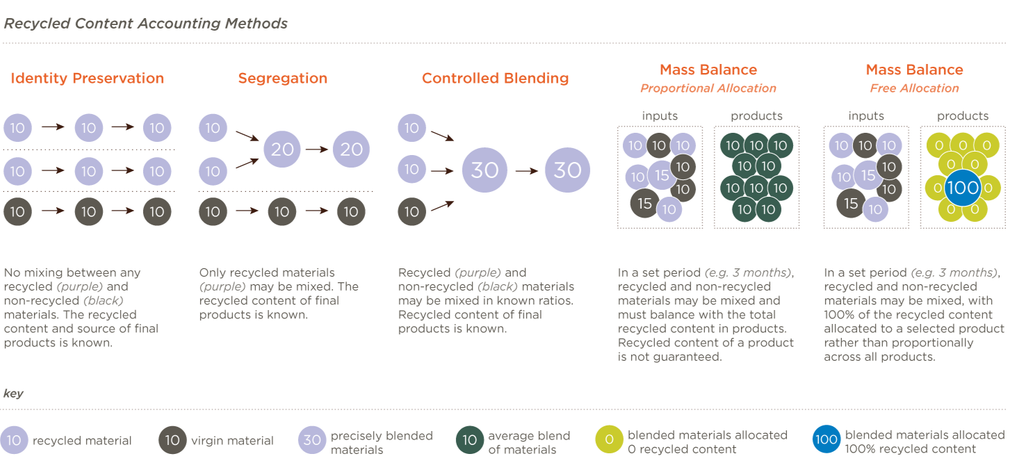
The five accounting methods recognized in Declare 2.1 describe different ways recycled materials can be tracked and assigned to products. Some follow the physical journey of recycled materials, while others use accounting approaches to determine how recycled content is allocated when materials are mixed.
- Identity Preservation
Recycled material from a single source is kept physically separate and identifiable throughout the supply chain.
In practice: A manufacturer receives recycled material from a specific source and maintains its identity as it moves through processing and into the finished product. - Segregation
Recycled materials from different sources may be combined, but recycled material remains physically separate from equivalent virgin material.
In practice: Several sources of recycled polymer may be combined, but the recycled polymer is kept separate from virgin polymer throughout the relevant stages of production. - Controlled Blending
Recycled and non-recycled materials are physically combined in known proportions, with controls used to determine the resulting recycled content.
In practice: A manufacturer combines recycled and virgin material according to a defined formulation and can determine the proportion of recycled material in the resulting product. - Mass Balance Proportional Allocation
Recycled and non-recycled materials may be physically mixed within a defined system. Recycled content is attributed to products based on the proportion of qualifying recycled material entering the manufacturing system and the applicable accounting rules.
The recycled content attributed to an individual product may differ from the physical proportion of recycled material in that particular product. - Mass Balance Free Allocation
Recycled content is allocated to specific products within a system using predefined accounting rules rather than being directly tied to the physical flow of recycled materials into each product. This allows manufacturers to assign recycled-content credits to specified products without being tied to the physical composition of individual products.
Do these methods mean one product is more recycled than another? Nope! Instead, they describe different ways of tracking and allocating recycled content to products.
ISO 22095 establishes the broader chain-of-custody framework, and ISO 22095-2:2026 provides specific requirements and guidance for mass-balance systems, including system boundaries, conversion factors, and methods for attributing specified characteristics to material flows.
What Does This Mean for Declare 2.1?
New to Declare 2.1, the label separates two different kinds of recycled-content information: what recycled materials are in the product and how much recycled content does the finished product contain, and how is that content accounted for? This distinction allows Declare to maintain its focus on ingredient-level transparency while accommodating recycled materials whose composition may vary and supply chains that use different chain-of-custody approaches.
Recycled Content in the Bill of Materials
- Recycled Content in the Bill of Materials
The Bill of Materials (BOM) describes the known chemical composition of a product, including the composition of recycled inputs where that composition can be identified. When recycled material has a well-defined composition, manufacturers disclose its known constituent substances using CAS RNs or other identifiers accepted by Declare. These substances are identified as recycled content and remain subject to applicable Declare disclosure and hazard-screening requirements.
Well-Defined Recycled Content
This pathway is appropriate when the composition of a recycled input can be reasonably identified across production.
Manufacturers:
- Disclose known constituent substances using CAS RNs or other Declare-accepted identifiers
- Identify those substances as Recycled Content
- Apply applicable Declare disclosure thresholds and hazard-screening requirements
Variable Composition Recycled Content
Some recycled inputs have compositions that vary between batches, sources, or production runs. In these cases, the recycled material may not be reasonably represented by a fixed list of substances.
Declare 2.1 provides a Variable Composition Recycled Content pathway for these situations.
Manufacturers:
- Create a component named Variable Composition Recycled Content
- Assign the component an appropriate functional role, such as filler, base polymer, metal alloy, or reinforcing fiber
- Disclose known constituent substances as sub-ingredients and identify them as Recycled Content
- Do not need to provide CAS RNs for constituents that genuinely cannot be identified
- Continue to screen all known substances for compliance with applicable Declare requirements
The goal is to provide as much ingredient transparency as the manufacturer can reasonably support without requiring a variable recycled input to be represented as having a composition that it does not actually have.
2. Recycled Content as a product-level summary
The BOM and the product-level Recycled Content field answer different questions.
The BOM tells us about the chemical composition of the product and its recycled inputs.
The optional Recycled Content field provides a product-level summary of the amount and source of recycled content and the method used to account for it.
Manufacturers that choose to complete this field provide:
- Pre-consumer recycled content: percentage range
- Post-consumer recycled content: percentage range
- Recycled Content Chain-of-custody/Accounting Method
This information provides additional context about the recycled content of the finished product without replacing the ingredient-level information in the BOM. This field is optional and does not impact Declaration Status or Living Building Challenge compliance.
Why Does Declare Separate These Two Types of Information?
Consider a product manufactured using a recycled polymer whose composition varies from batch to batch.
The BOM needs to communicate what is known about the substances in that recycled material. But the manufacturer may also need to communicate a product-level recycled-content percentage based on its supply chain and accounting method.
Those are related—but different—pieces of information.
The BOM answers: “What substances are in the product?”
The Recycled Content field answers: “How much recycled content is attributed to this product, where did it come from, and how was it accounted for?”
Keeping these two forms of disclosure separate allows Declare to provide meaningful ingredient transparency while accommodating the way recycled materials are actually sourced, processed, blended, and accounted for in modern manufacturing.
A more transparent way to understand recycled content
A recycled content percentage is only one part of the story. Understanding recycled content also means understanding the journey of a recycled material through sourcing, manufacturing, and into the finished product. Specifying the chain-of-custody and accounting methods help make that journey easier to understand, while bringing greater transparency and accountability to recycled content claims.
Declare 2.1 brings these pieces of information together in a way that distinguishes chemical composition from product-level recycled-content reporting.
That distinction matters. It allows manufacturers to provide meaningful information about recycled materials without implying that every recycled-content claim is based on physically tracing the same material from source to finished product.
The result is a clearer picture of both what is in a product and how recycled content is being reported.
Want to learn more?
Read the detailed requirements and instructions for reporting recycled content in the Declare 2.1 Manufacturer Guide.